


Motorcycle riders face a much higher risk on the road than most people realize. In 2024, riders accounted for 16% of all traffic deaths nationwide, according to the National Highway Traffic Safety Administration, even though motorcycles make up only a small percentage of vehicles on the road.
Nevada has also continued to report high numbers of motorcycle fatalities, with 83 rider deaths recorded statewide in both 2024 and 2025. Poor visibility, changing road conditions, and distracted drivers can make even a normal ride dangerous in seconds.
What that means for you is simple: cars are getting safer while bikes are not. Those wrecks and personal injuries are not random. Most trace back to the same seven crashes that show up in police reports year after year.
Knowing what those seven motorcycle accident causes look like, where they happen, and how to ride around them is the difference between coming home and becoming a victim.
Why Nevada Roads Are Especially Tough On Riders
Las Vegas pulls in 38.5 million visitors every year, flooding roads with distracted, unfamiliar drivers who don’t watch for riders like you, leading to catastrophic injury settlements.
With more vehicles on Nevada roads each year, motorcyclists have less room to react to sudden lane changes, distracted drivers, and unpredictable traffic conditions. Even light rain can make riding more dangerous, especially after long dry periods when oil and debris build up on the road surface. In these conditions, staying alert and adjusting your riding habits becomes even more important.
Most riders can predict these crashes before they happen. The driver waiting to turn left. The SUV drifting toward the lane line. The tourist staring at a GPS instead of the road. The challenge isn’t recognizing danger. It’s recognizing it early enough to create space before it becomes a crash.
Top 7 Causes Of Motorcycle Accidents In Nevada
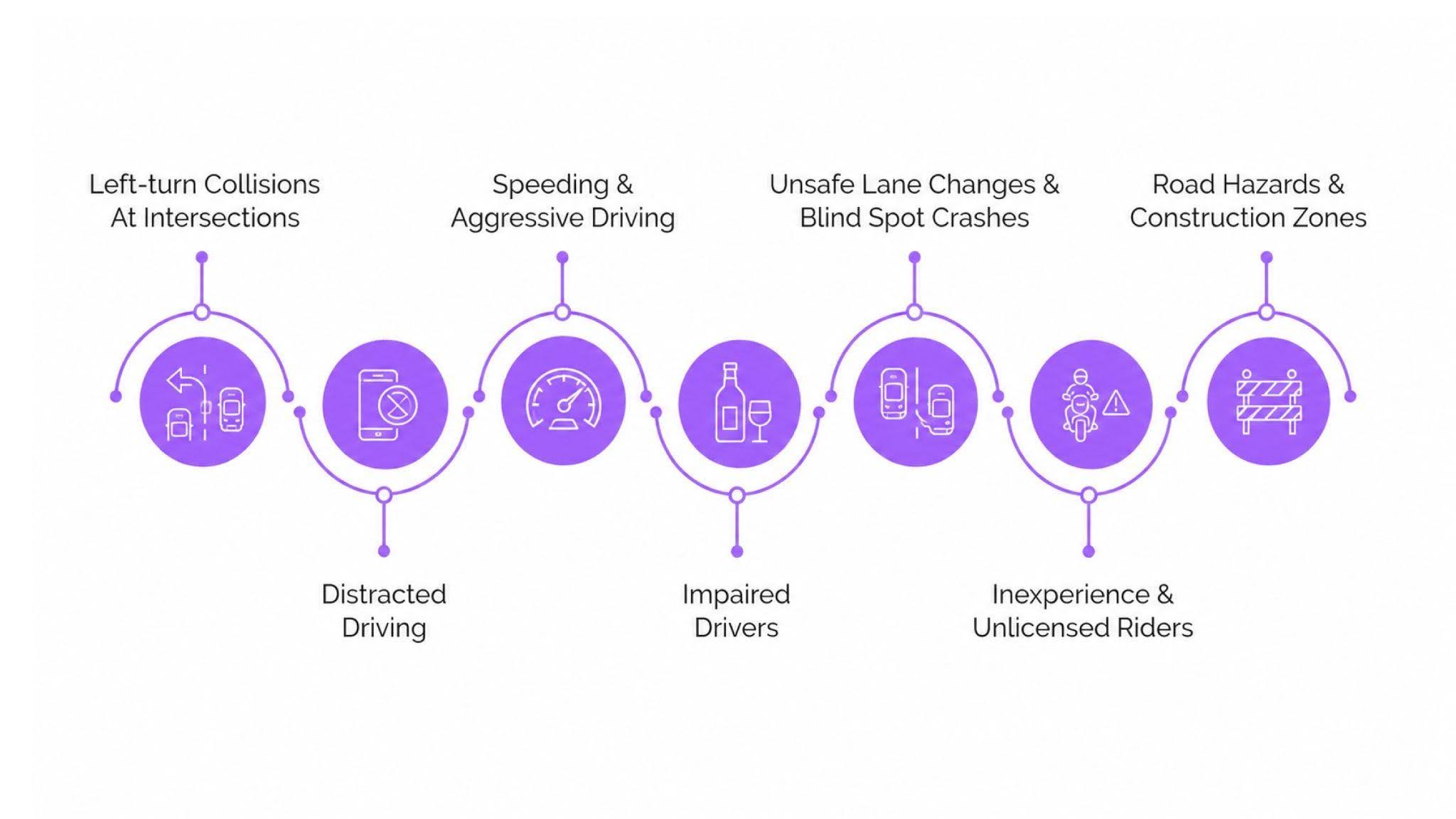
These are the seven recurring factors behind serious rider crashes in Nevada, ranked by frequency in real crash data.
1. Left-Turn Collisions At Intersections
Roughly 42% of fatal two-vehicle motorcycle crashes happen when the other vehicle turns left while the motorcycle is going straight, passing, or overtaking. The driver fixates on the gap between cars and never registers the narrow profile of a bike. Intersections like Tropicana and Pecos, Flamingo and Las Vegas Boulevard, and Rainbow and Charleston repeatedly show up in fatal crash clusters.
Cover the brake through every intersection, ride where turning cars can see you, and treat a flashing yellow arrow as a guaranteed left turn coming at you.
2. Distracted Driving
NHTSA reports thousands of annual deaths tied to phones, infotainment screens, and in-car distractions. Nevada’s tourist drivers add another layer, constantly looking up addresses, scenery, and unfamiliar freeway exits.
A driver looking down for two seconds at 45 mph travels the length of a basketball court blind. High-visibility gear, modulated headlights, and aggressive lane positioning around drifting vehicles reduce your exposure.
3. Speeding and Aggressive Driving
Speeding or aggressive driving shows up in roughly a third of fatal Nevada motorcycle crashes, the highest rate among top-risk states. The I-15 corridor between Las Vegas and the California border, US-95 north of town, and the 215 Beltway all experience chronic high-speed traffic that punishes even small mistakes.
Riding in the right two-thirds of a lane gives you a buffer from aggressive lane-changers. Slowing five to ten under in heavy weekend traffic flow is rarely a bad call when you spot weaving cars ahead.
4. Impaired Drivers
Zero Fatalities Nevada identifies impaired driving as a top contributor to Nevada traffic deaths, accounting for 47% of total traffic fatalities. Friday and Saturday nights between 10 PM and 3 AM carry the highest impaired-driver density, with the Strip, Fremont Street corridor, and Henderson casino routes hit hardest.
If you ride those windows, assume every car behind you is impaired until proven otherwise. Stay out of the far-left lane near casino exits, where drunk drivers cut across multiple lanes to reach freeway ramps.
5. Unsafe Lane Changes and Blind Spot Crashes
Motorcycles vanish in a car’s blind spot, especially next to SUVs, pickups, and box trucks. Drivers who skip a mirror check or signal change lanes directly into riders. Highway merges on I-15, I-215, and US-95 are the worst offenders because drivers cross multiple lanes at the last second to reach an exit.
Never ride parallel with another vehicle. Either pass cleanly or drop back so you are out of the door zone. If you see a head check, expect a lane change even without a signal.
6. Inexperience and Unlicensed Riders
LVMPD has identified rider inexperience as a causal factor in many recent motorcycle fatalities, and NHTSA reports that 34% of motorcycle riders involved in fatal crashes nationwide in 2023 did not have valid motorcycle licenses.
Take a Motorcycle Safety Foundation course before you ride, earn your Class M endorsement through the Nevada DMV, and gradually increase displacement. Track days are safer than canyon runs for learning the limits of a fast bike.
7. Road Hazards and Construction Zones
Las Vegas is in near-constant construction. Loose gravel, uneven pavement seams, sudden lane shifts, potholes, and unmarked detours catch riders off guard in ways they never affect cars. Add summer monsoon oil slicks and the occasional desert sand drift, and surface hazards become a real threat.
Scan four to twelve seconds ahead, soften your grip when crossing seams or painted lines, and avoid the center of a lane in stop-and-go traffic where oil and coolant pool.
When and Where Nevada Motorcycle Crashes Turn Deadly
NDOT crash data shows most Nevada motorcycle fatalities occur in urban Clark County between noon and 9 PM, peaking in late summer and on weekends. Heat above 100 degrees fatigues riders and softens grip. July and August monsoons drop sudden rain on roads that haven’t seen water in months.
Routes that repeatedly produce fatal crashes include State Route 160 to Pahrump, the Red Rock Canyon loop, Mt. Charleston’s switchbacks, and Boulder Highway through Henderson. Riding those roads after dark, in heat, or in unfamiliar weather stacks risk against you.
Get Reliable Legal Support After A Motorcycle Accident In Nevada

Motorcycle crashes create questions most riders never expected to face. Medical bills, insurance claims, car or motorcycle insurance, missed work, damaged bikes, and uncertainty about what comes next. If you’re dealing with the aftermath of a motorcycle crash, talk with a team that understands riders and Nevada motorcycle cases. At Legal Ride, you get practical guidance, motorcycle-accident-focused insight, and support tailored to the crash that changed your day.
FAQ: Causes of Motorcycle Accidents in Nevada
Between noon and 9 PM, with weekend evenings the deadliest window as impaired-driver density peaks around casino and bar closing times.
No, lane splitting is illegal under NRS 486.351. Lane sharing, where two motorcycles ride side by side in one lane, remains legal.
I-15 between Las Vegas and the California border is prone to congestion due to high speeds, tourist traffic, and complex interchanges. The Red Rock Canyon loop and Mount Charleston also see frequent loss-of-control wrecks on curves.
Yes, the CDC estimates DOT-approved helmets cut death risk by 37 percent and head injury by 69 percent. Nevada mandates helmets for all riders and passengers.
Yes, inexperience drives most recent Nevada motorcycle fatalities per LVMPD, particularly on high-displacement sportbikes. New riders crash disproportionately within their first six months on the road.
This content is for informational purposes only and does not constitute legal advice. Every case is different. Consult an attorney for advice specific to your situation.
Legal Ride
Latest posts by Legal Ride (see all)
- What to Do After a Car Accident Without Insurance in Nevada - September 30, 2026